Maria Sipka's Column
“Friends Without Borders” is Catalyzing Friending in Conflict Zones to Create World Peace
By enabling people from diverse backgrounds to easily connect and share their ideas, can we decrease world conflict in the short and long term? Yes.
Some interesting phenomena unfolded recently during a peace research innovation across eight countries in conflict or post-conflict transition. These countries (India, Pakistan, Israel, Palestine, Greece, Turkey, Albania and Serbia) identified friending patterns on the social networking site Facebook.
The results are astounding! Take a look for yourself and see real-time results published on Facebook’s Peace on Facebook page, of friend connections created each day between people of different countries, religions, and political affiliations.
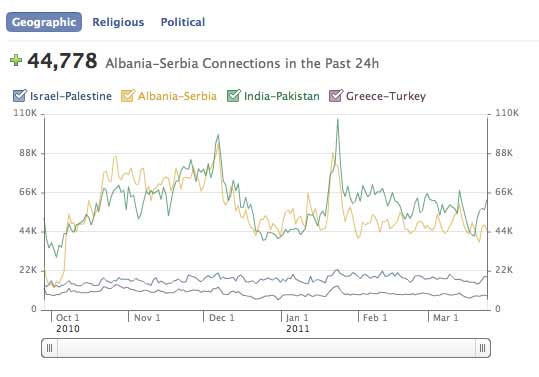
It’s interesting to compare the level of friending in relation to the Facebook populations in these paired countries:
Israel + Palestine: High level of Facebook populations and high level of cross-conflict friending. Great peace-building potential!
Greece + Turkey: High level of Facebook populations and very low level of cross-conflict friending. A great deal of effort will need to be invested to build connections here.
Albania + Serbia (post-conflict transition): High level of Facebook populations and very high level of cross-conflict friending. Fantastic level of connections.
India + Pakistan: Very low level of Facebook population and very low level of cross-conflict friending. Great effort to cultivate friending and hard work on peace-building here.
Social development advisor Jane Chesher has been awarded a UNESCO “Power of Peace” initiative grant to catalyze a powerful global outreach campaign to foster cross-conflict friendships among youth 14-25 years in each region. The initiative is titled Friends Without Borders.
Partnering with Stanford University Persuasive Technology Lab and Facebook, the project’s goal is to promote peace, respect, trust and empowerment between youth from opposing countries in the four geographic conflicts shown on the info graphic below using social networking, film and story.
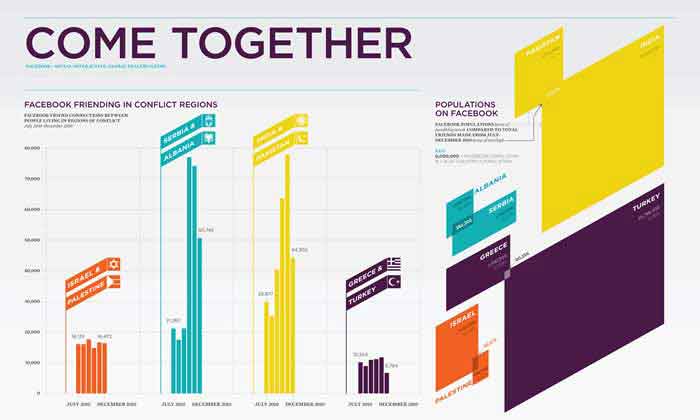
Since the launch of peace.facebook.com in August 2010, the volume of friend connections made each day in the conflict countries has doubled. Today there are over 100,000 new friend connections made every day across the conflicts.
The Friends Without Borders movement will scale up and empower the connections by creating a safe and fun online space to expand the network through peer influence, trust and respect for the “other.” Facebook analytics will be used to track the impact of the campaign, along with traffic data provided by promotional ads and links, including partner outreach.
If you would like to learn more about the Friends Without Borders initiative and become involved you can contact Jane through her website.
Maria Sipka is the CEO and founder of Linqia – an online marketplace helping companies identify, connect and engage with masses of highly targeted consumers participating in online communities and groups. Follow Maria on twitter or contact her on LinkedIN.
Back to top
Share Your Starfish Story
AARP staffer Ernie Powell shares this story of how he used the Starfish catalyst leadership style to implement changes at work.
AARP hired me in 1993 to do legislative and policy work. During all of those years I have been working in California on both national and state issues. But my background has always been in grassroots organizing.
In the sixties and early seventies I worked for the farm workers’ movement. Later I was a community organizer in Southern California. I have done campaigns, neighborhood organizing and policy/strategic development.
Within my first year at AARP I observed that our orientation in building effective advocacy campaigns was much too tactical and not strategic enough. We would have a problem getting a vote from a House member on some issue and right away we would jump to tactics —“Let's have a rally, let's do a petition." But the full framing of it, the full strategic outlook was not very well mapped out.
A colleague and I wrote some memos and presented some ideas in order to shift the way we trained and organized at the grassroots level. We convinced AARP that it needed to start doing a better job of looking at issues from a deeper strategic perspective. We developed a relationship with the Midwest Academy in Chicago and in so doing we started putting together training in Direct Action Organizing (DAO).
Many years later every office in the country uses this planning and strategic tool, and thousands of staff members and volunteers have received the training.
For two months last summer I worked as the interim director of the Utah AARP office. While sitting in my temporary rental apartment in Salt Lake City I read a blog that said the following:
"If you want to figure out how the Tea Party happened, read The Starfish and the Spider."
After reading Rod’s book, I understood that the work of my AARP colleague and I was an example of a catalyst style of leadership, as described in the book. Working as catalysts enabled a few of us to shift AARP in ways that helped us win more victories and engage in a better way.
Back to top
Starfish Principles At Work

Bay Area Riders Forum
Earlier this year Rod had lunch with Dan Frank, a friend who was a Vice President at Onsale, the original online e-commerce company discussed in The Starfish and the Spider that preceded eBay. Frank mentioned that it was amazing to him to read the story about his old company in Rod’s book. He also told Rod about another starfish-style community he’s involved in—the Bay Area Riders Forum, an online community of motorcycle enthusiasts commonly known as BARF.
BARF exemplifies two major starfish organization principles—it has a catalyst rather than a top-down leadership hierarchy, and the members spontaneously create activities and programs.
A member named Budman manages the website, but other than keeping the site running, (including some basic fundraising activities to support it), in true catalyst fashion he lets the community manage itself. Several moderators keep things marginally civil in the chat rooms, in which a locker room style of conversation prevails.
The San Francisco Bay Area has one of the most concentrated populations of motorcyclists anywhere in the world. The weather, traffic, abundance of winding mountain roads, and other factors make the area ideal for bikers. BARF has over 39,000 members, with demographics that run the gamut of CEOs, law enforcement officers and outlaws.
The BARF community is united by concerns about the dangers of the road, legal rights, and the attitudes of law enforcement and other drivers towards them. Their shared concerns and love of the sport create a tight community.
Here are some examples of how members contribute to the community:
- Keith Code is an author, coach to many professional superbike champions and founder of California Superbike School. He regularly answers questions from BARF members on the forum and occasionally will conduct a free training session.
- The forum site includes a list of members with tow capabilities who can help if members need assistance.
- A number of biker law enforcement officers (referred to as LEOs) will answer any questions other members have on topics from how to register an out-of-state vehicle, safety issues, the location of speed traps, how to get out of a ticket, etc.
- Member Doc Wong does free weekly training sessions and group rides. He has trained many thousands of riders. He also conducts first aid training for riders, and occasional free medical exams and x-rays for people who have riding pain.
- There is a forum on the BARF site called Crash Analysis. Anyone who has an accident will post there. A number of instructors from the Motorcycle Safety Foundation (MSF) will ask questions and comment in the hopes that the whole community can learn from the accident and how to avoid similar situations in the future.
- Members freely help each other with maintenance, technique, racing, planning a trip and any other bike related issues. Dealers, manufacturers, and racers all patrol the forums and chip in.
- Occasionally members will do a fund raiser for an injured rider.
- Members can post stolen bike notices and everyone will look out for it.
- They try to keep things democratic. For example, they wanted a BARF t-shirt, so they let any member submit designs and then the group voted on the winner. Site users may chip in with web design help as well.
- The community has worked on a number of legislative and awareness campaigns. Members succeeded in getting electronic highway signs to flash the message, “Look twice for motorcyclists”
Perhaps the most important element of BARF is the huge safety culture. Anyone caught doing reckless things or bragging about stunts, excessive speeding, riding without appropriate gear, etc. gets quickly admonished by the community. The BARF community’s attitude and the training members provide saves lives.
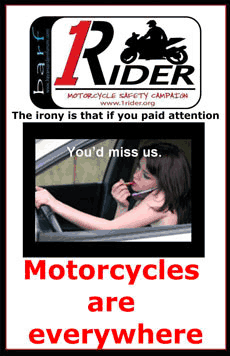 Dan Frank suggested that we contact Budman, the member who runs BARF, to learn more about this fascinating community. Denny “Budman” Kobza is the head of Dennis Kobza & Associates, Inc., an architectural firm located in Mountain View, California. In addition to running BARF, he is also a Group X instructor for 24 HR. Here are the results of our interview: Dan Frank suggested that we contact Budman, the member who runs BARF, to learn more about this fascinating community. Denny “Budman” Kobza is the head of Dennis Kobza & Associates, Inc., an architectural firm located in Mountain View, California. In addition to running BARF, he is also a Group X instructor for 24 HR. Here are the results of our interview:
Q: Who started BARF, and when?
A: Steve Cole founded BARF on January 3, 2002. I was member # 189 and joined in April 2002 when BARF was still a small community. I became a moderator in July because of my racing experience and enthusiasm. I later became Steve’s partner and took the site over in 2005. My wife Loura does all of the books and back ground work to allow me to have fun and chase my goals with the site.
Now BARF has over 39,000 members from around the world. We also have a race team that includes two of the top racers in California, a 13 year old young gun, a 7 year old and a 60 plus land speed racer. We also sponsor a couple of others as well.
Q: BARF supports a fundraiser every year in La Honda for the rescue workers that handle motorcycle accidents. How is this event organized? Is there a leader who handles this each year, or do different people volunteer each time?
A: BARF member Harry “Doc” Wong has been a riding advocate for years in the Bay Area and he is the main organizer every year, in collaboration with the Volunteer Fire Department. The event raises most of the funds through raffle ticket sales. It’s well attended by many BARF members, sponsors and other moto organizations along with the volunteer fire departments and other agencies that may serve to help scrape us up off the pavement!
Q: There seems to be a strong focus on safety on the BARF site that goes against the stereotype of bikers being a mean, rough and reckless group, thanks to the Hell’s Angels image. How would you describe the spectrum of people who belong to BARF?
A: The Hell’s Angels stigma is still around. This is a sport bike community and many are professionals and tend to be quite opposite the stigma. BARF has a vast range of members from the teens to 70-plus, from mechanics to engineers to doctors and more. Our community has an amazing amount of very educated and experienced members.
But there’s a dark side to the sport bike community that includes three basic problems: The stunters who do wheelies in public areas, the canyon carvers who ride at high speed on well-travelled roads, and aggressive lane splitters. All of these activities give the general public a bad perception of motorcyclists. The reality is that it’s only a small percentage of the motorcycling public doing these things. Most of these guys, like the rest of us, are good people—they’re just more aggressive and less sensitive to public perception.
Q: BARF member Dan Frank mentioned that anyone caught doing reckless things or bragging about stunts, excessive speeding, riding without appropriate gear, etc. gets quickly admonished by the BARF community. How do BARF members reconcile frequenting biker bars like Alice’s and Apple Jacks, where some drinking probably occurs, with adhering to safe riding practices such as “don’t drink and drive”?
A: On BARF there’s a strong feeling that radical actions on the streets lead to a negative public view towards us and should be countered. We see this often and some of it is due to the difference in ages of our membership. The experienced riders tend to understand that some of these actions can be fun, but also with so many new and younger riders a tone needs to be set that those actions are generally not acceptable.
The lack of gear is not necessarily a public problem, but it shows a lack of basic understanding of what happens when you fall off without proper protection. We have a saying on the site: ATGATT. This means “All the Gear All the Time.” Veteran motorcyclists have likely fallen off before and experienced the asphalt ripping at you and the impacts that tumbling on the ground produce, let alone hitting something solid. That message is strongly broadcast and fairly well accepted. We see new riders talking about upgrading their bikes, but not yet having all the right gear and the members quickly point out the fact that gear is more important than some trick part to increase performance or the cool factor of their machine.
I have crashed quite a few times over the course of my 40-plus years of riding and have had very limited injuries because of wearing proper gear (and being lucky). When you hit the pavement at 120 MPH (which I did racing) or even 25 MPH the lack of gear can cause injuries that will leave scars for a lifetime.
It also causes the loss of riding time and being able to go to work, which is another factor. Wearing the proper gear as long as you don’t hit a solid object will usually find the rider shaken, but likely OK and walking away. We have seen this on the site many times and you always see it at racing events. The helmet is always priority #1 because so is the head. Many of us have had impacts to the head that would leave us dead without a helmet (I would believe in my case more than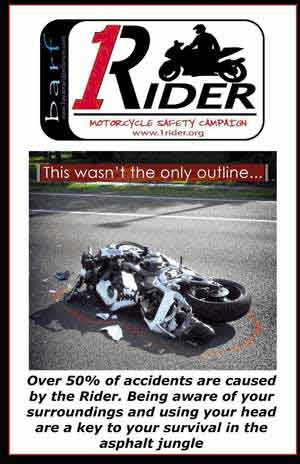 ten times). ten times).
The other thing that BARF has developed is an educational forum and safety effort we call 1Rider. This came out of our own frustration over seeing members hurt or killed. We’ve seen many injuries and deaths locally, and members tend to link news of fatalities from around the country. These examples help reinforce the possible dangers of riding a motorcycle and not being prepared or just being stupid.
Some accidents are out of our control and those are the scariest scenarios for most. The 1Rider forum on BARF has many threads about thinking it through and sharing information gained from experience, so others won’t have to live through it to learn about it, like I had to as a kid. We make appearances in the hot riding spots in the hills and some local high schools too. We have generated graphics and information for riders and the public to see as well.
The 1Rider effort has been noted by the State of California and I now sit on a State Committee, along with one of our moderators (Motor Officer John Hurd from Livermore), tasked with finding ways to reduce motorcycle fatalities. This committee, which includes the California Highway Patrol, Office of Traffic Safety, Motorcycle Safety Foundation, Department of Motor Vehicles and others, are responsible for the motorcycle safety messages that appeared on the Amber alert signs along the freeways last year, and more good things are coming out of it. The CHP and other agencies know that BARF cares about motorcyclists and will work with them to help improve safety through training and education.
As far as drinking and riding it is a big problem in terms of the percentage of accidents that result from this dangerous combo. The sport bike community is generally much less likely to do so than other motorcycle groups. They tend to meet for coffee rather than beer on rides. They may go to Alice’s (a favorite local spot), but they eat and socialize rather than drink.
BARF does have lots of social events that are in bars or place where alcohol is pervasive, but the membership watches each other pretty well. If someone rode we see the same caring in real space (we call it meet space) as you see on the forum. The community watches over our own pretty well. Being such a diverse group there are always exceptions, but we don’t ever see BARF rides that are from pub to pub as you see with other groups. That is a damn good thing!
Back to top
Eco Corner - Rod has been on the Environmental Defense Fund Board since 1994
How the Kyoto Protocol Came About
Rod has been on the Environmental Defense Fund Board of Trustees since 1994. In 2007, Rod interviewed Dan Dudek, Chief Economist of the Environmental Defense Fund, who was one of the co-authors of the Kyoto Protocol, and a world-leading expert on environmental markets and how to shape them, design them, put them into policies and make them work. As far as we know, this was the first time Dan granted such an interview, so we are very pleased to share another installment from this historic event in this edition of "The Beckstrom Starfish Report."
Rod: Let’s talk about what happened in Kyoto. How did the protocol come together? How did Gore end up getting behind that and taking that to Japan?
Dan: It’s pretty clear that right from the beginning the Clinton Administration fought for the need and the responsibility to do something about the greenhouse gases. I think in large measure this was due to Vice President Gore’s influence.
They began with an internal process of convening stakeholders throughout the country, talking about what the different strategies could be. There was a proposal for a BTU tax or something of that sort, early on in the Clinton Administration. They gave serious consideration to a carbon tax, regarding what we might do in terms of managing domestic administrations, which of course, had the half-life of an ice cube at the Equator. But the international process, which began in 1992, was simultaneously in motion.
Rod: Is that IPCC you’re talking about or the UNFCCC?
Dan: I’m referring to the United Nations Framework Convention on Climate Change (UNFCCC). They held the Earth Summit in Rio de Janeiro, Brazil in 1992, and formed an international treaty which the United States signed and has ratified, unlike the Kyoto Protocol.
The Kyoto Protocol is the operational instrument specifying what nations will do to implement the policies initiated in Rio in 1992. So we have the Clinton Administration’s participation in the Earth Summit treaty in Rio in 1992, we have ongoing negotiations in 1995, we have the so-called Berlin Mandate, which set up the principle that developed nations must act before developing nations, and a whole series of ongoing consultations internationally, which led up to the event in Kyoto, Japan in November of 1997.
During this process, there was also a parallel process inside the U.S. government of massive head-scratching about what we were going to do; what we were going to put on the table. There was an acknowledgment that the situation looked serious, that something important was happening.
Fortunately, the U.S. had implemented the acid rain program and was building not only credibility, but also respect, particularly amongst the industry. We had some good examples from the Montreal Protocol--things like the concept of a basket of gases, grouping all the gases together rather than isolating them individually. There were a number of things happening.
Rod: So you brought them together and you developed this conversion ratio, right?
Dan: Exactly.
Rod: So everything gets translated back to CO2 equivalents?
Dan: Right. So we’re back to CO2, in terms of its so-called “global warming” potential.
Rod: This is good for the market, because you need to have flexible standards. The more liquidity you have around the base unit, the more efficient the market can be.
Dan: Absolutely. And it’s also good for the environment, because we’re capturing all of those other culprits.
Rod: You could have ignored the trace gases otherwise, but those HFCs and others can be pretty nasty.
Dan: They are quite potent, as we’ve seen. So, internally, there was this process going on, and as I said, I think it’s fortunate that real credibility was established with the acid rain SO2 market. There was a core group in the Clinton Administration who had experience on the hill with respect to the development of the acid rain program.
One was Hazel O’Leary who was the Secretary of Energy. She came from an electric utility and had experience and background in the SO2 program. There were a number of different people within the administration who thought that maybe they could do something about global warming. As part of Environmental Defense we were invited to participate in some of these consultations.
Rod: By whom? The White House, or by the UN, or by the triple C group? Who was organizing this?
Dan: The White House empanelled an inner agency consultative group. Our invitations came from the Department of Energy. At that time, I sat on the Secretary of Energy’s Advisory Board. Invitations also came from the Environmental Protection Agency, on the basis of the work we had done on acid rain.
One Christmas morning I sat at my in-law’s kitchen table and sketched out the major elements of how a greenhouse gas trading program would work from an international perspective.
Rod: Do you still have those original papers?
Dan: I have a collection of boxes of archival materials in my barn.
Rod: So in your mind, was that the first draft concept for the Kyoto Protocol? At least, that you worked on?
Dan: That’s correct.
Rod: And then you put that into a draft form for the working group to consider?
Dan: Yes, that went to the internal working group, and to the U.S. government, and then we followed that up by lobbying our friends, colleagues and other interests to support the concept as well. In addition to developing testimony on the hill about a greenhouse gas trading program, we also presented a number of these ideas to negotiators internationally.
For example, the UNFCCC treaty included a target specifying that by the year 2000, countries will return to 1990 emissions. If you think about that, you’ll realize that it’s not a very operational target. It’s not specific enough. Does that mean we will just have achieved 1990 emission levels by the end of 1999 and then at the first moment of the year 2000, the emissions are going to take off again?
How do we operationalize this idea? So we decided we needed a budget. We needed an accumulative block of emissions that people can actually manage. It’s much more practical this way because economies are changing all the time.
It doesn’t really matter where emissions levels are at any one specific moment in time, because this is a problem that’s occurring over decades, if not centuries in terms of accumulation, and in the atmosphere. So what we needed to do was change the inertia, to change the momentum, and we wanted to do that in a way that gave people flexibility to accommodate economic changes.
Who knows when a sub-prime mortgage event is going to hit the economy, or some other financial tsunami that’s going to affect economic performance and level of emissions?
Rod: So let’s bring it back to new Nobel Prize winner, Al Gore. You and the team, and this inner government panel convened by the White House, came up with the framework for the Kyoto Protocol? And then Gore basically picked up the baton and flew to Kyoto, and performed the world’s greatest sales job? What happened in Kyoto?
Dan: Well, in some sense, you just captured the essence of what happened. The United States was backing emissions trading as part of a coalition of nations that also included Japan, Norway, Australia, and New Zealand. These countries were interested in flexibility mechanisms such as emissions trading.
Others, primarily Europeans and most environmentalists, opposed the concept of emissions trading. They saw this as an attempt to evade the responsibility of controlling emissions, so the negotiations in Kyoto were extremely tense and really difficult. The Kyoto Protocol was considered the world’s first greenhouse gas trading program with the world’s petroleum, because back in 1995, we started doing work with BP.
Rod: Sir Lord Brown?
Dan: Yes, but he wasn’t a sir at that time. BP initially started with a set of business units they ran on their own, and then expanded that to a global commitment and target.
During the Kyoto conference, we had a side event where we described and discussed the mechanics of how this happened. It gave negotiators the opportunity to come and kick the tires, if you will. In fact, this session was chaired by Yvo de Boer, who was Executive Secretary of the UNFCC.
This was in November, 1997 and negotiations were deadlocked. It didn’t appear that we were going to be able to achieve agreement because the United States was absolutely set on having flexibility regarding emissions reduction. We had to have a way to control costs.
Rod: You mean the other countries were happy to have a solution that didn't involve trading?
Dan: The other countries saw this as an opportunity to inflict economic pain on the United States.
Rod: Congratulations on making such a good point.
Dan: The United States has pursued economic development policy built on cheap energy. Other nations haven't because their energy supplies haven't been as abundant as ours have been.
In Japan and Europe, for example, energy is priced much differently than in the United States. Although these economic development strategies had been in place for 100 years or more, you get to Kyoto and all of a sudden these strategies are core virtues that have nothing to do with the relative resource endowments of countries.
So some people felt strongly that it was important to get the United States to change its profligate energy ways. That meant changing the competitive terms of trade between the United States and Japan.
Rod: So was it that they didn't want to allow trading between America and other countries so we couldn't buy ourselves out of our pollution problem? Or was it that they didn’t want the United States to have domestic trading because they wanted to penalize the individual corporations, or was it both? Was there a desire to penalize on all fronts?
Dan: I think they recognized there was no other international framework that would hold individual sovereigns responsible for their domestic trading.
Rod: So they could have it however they wanted, with capital trade or another solution?
Dan: Yeah, pretty much.
Rod: What about regulation?
Dan: There could be subsidies and technology development and whatever else they wanted to do. This was an international issue. The modeling leading up to Kyoto showed that there were very significant cost savings on a global basis available from using the flexibility mechanisms. And some countries, like the United States, could benefit the most from these savings.
Rod: Can you give an example?
Dan: Well, in a lot of respects, environmental negotiations at the international level are also trade and finance negotiations. We can't escape the business reality. So there we were, deadlocked. The Europeans were pounding on us, and on Environmental Defense, which was also supporting emissions trading.
There was a lot of discussion among the U.S. delegation about what to do about this. Finally, they proposed that Vice President Gore fly out to the negotiations, so he did. I was one of a handful of people who was asked to both greet and brief him upon his arrival in Kyoto.
I think his personal presence was catalytic in creating the circumstances which led to agreement. There's no mistaking the importance of his personal presence in achieving the agreement in Kyoto. Unfortunately, although the United States signed the Kyoto Protocol, we have not yet submitted it to the senate for ratification, so we are still in the position of being isolated and outside the international framework.
In the next edition of "The Beckstrom Starfish Report" we'll share the final installment of this historic interview, where Dan explains why he holds hope that we can turn global warming around.
Back to top
© 2011 WWW.BECKSTROM.COM
Unsubscribe
|