What Rod's Been Up To
Breakfast With Bhutto
 |
On September 25, 2007, Benazir Bhutto shared breakfast with a small group of friends near Washington, D.C. She wanted to say goodbye before heading back to Pakistan. Through mutual friends, I was present.
Ms. Bhutto articulated how she planned to drive al Qaeda out of her country by partnering with local chieftains in the Pashtun region. She shared her plans for improving education and democracy. She found much fault with President Musharraf’s leadership.
I took issue with her criticism of Musharraf as I had witnessed his courageous stand for peace when I helped initiate Track II diplomacy between India and Pakistan in 2003 and 2004. In five trips to the country, I developed a fondness for the people, their history and culture. I respected Musharraf for leading the country in a direction that was much needed but not always popular to all. I had driven over the bridge into Rawalpindi where al Qaeda tried to assassinate him and instead killed sixteen others, and I came to appreciate the magnitude of the risks he has taken.
In Pakistan, I learned that many business leaders consider the present administration more capable and honest than regimes of the past. In contrast, they viewed Ms. Bhutto’s reign as extremely corrupt, and some critics pointed to her personally when they referred to two billion dollars that went missing.
I asked Ms. Bhutto how she would handle corruption this time, given the stories of her previous administration. Without losing her stride, she said, “Rod, you know they killed my father. They killed my brother too. Then they imprisoned my husband. The same people are trying to tar me with corruption, but where is the money? Where are the bank accounts?”
Only she could know the answer, of course, and I was not satisfied with her response. At the same time, I respected her passion for Pakistan and her sincere desire to return to her country, with great hopes to lead it. Nothing could have stopped her. She was determined to go back.
Tragically, in going back she paid the ultimate price—she lost her life to the very terrorists she had hoped to drive from her country.
Some people have asked me what we can do now to help Pakistan. The answer is simple but not obvious. It comes from the Pakistani people themselves. I interviewed dozens of them when I was there during the horrific earthquake of October 8, 2005, and when I returned in January of 2006.
I had thought people would simply be asking for relief money and other aid. But they wanted something else — free trade.
Pakistan's extensive textile industry is greatly harmed by American and European tariffs, which price their goods out of our market. Pakistanis told me that the best thing we can do to help their country is to open up our markets and allow them to build industry and jobs. It’s high time that Americans practice what we preach by granting Pakistan the tariff relief her people deserve and need. I proposed this to several congressional representatives when I returned from Islamabad, but I did not find a champion or much traction.
The other thing Pakistan needs is more good modern schools and education. The Citizens Foundation (TCF), an amazing starfish network of volunteer executives, is building many of the best schools in the country. After the devestating quake, I camped out in a cold stone house in Muzaffarabad, the epicenter, with TCF volunteers. I was inspired by their effective, efficient work training Kashmiris to rebuild thousands of homes from the rubble. Their efficacy was amazing.
Rather than talking about Pakistan’s problems, isn’t it time we help them by doing something constructive? May we open our markets to their goods and may we help them build better schools.
Benazir Bhutto was assassinated in Pakistan on December 27, 2007.
February 2008
In this Month's Newsletter...
Welcome to this issue of The Beckström Starfish Report. You are receiving this because you have expressed an interest in information about Rod Beckström, his activities, and how the powerful concepts in his book, The Starfish and the Spider: The Unstoppable Power of Leaderless Organizations, are affecting the business world and society. If you don't wish to receive future issues of this newsletter, just go to the bottom of this page where you can quickly and easily opt out.
Please forward this newsletter to anyone you know who would benefit from knowing about the power of decentralized networks and the effectiveness CEOs can achieve when shifting to a Catalyst leadership model.
|

Rod's Other Activities Rod continues to be very involved with TWIKI.NET in addition to his busy professional speaking schedule. In December Rod presented at eBay headquarters in San Jose, California, and in early January Rod gave the keynote address at the Famous Entrepreneurs Speaker Series kickoff event in Syracuse, N.Y. Among the sponsors of the Syracuse event was ClearChannel, the largest radio network in the U.S. In conversations after the presentation Rod learned about ClearChannel’s hybrid management model. While high growth and profits are demanded, each business unit is allowed to innovate and grow as it wishes. This management system produces both high profits and much innovation. General Manager Joel Delmonico also told Rod about one of their newest products—a customized and decentralized radio program for listeners, delivered as podcasts to an iPod. Customers simply need to define what kind of music and news they want, and ClearChannel computers mix and serve up a custom radio program for each listener, which downloads automatically when they plug their iPod into the network through their PC. This is the beginning of personalized, starfish radio. On January 25, Rod keynoted at the Global Management Meeting of High Technology Consulting Firm Sogeti in France, and then traveled to Amsterdam, where he participated and spoke at TWiki MeetUp in Holland. Rod's presentation in Dubai, covered in the November issue of this newsletter, received some interesting press coverage in BusinessIntelligence Middle East. Rod remains very supportive of Kiva.org, the microlending organization for which he serves on the Advisory Board, and wanted to share some highlights from a recent Kiva Insiders Newsletter. The organization has already funded almost $14 million in loans in more than 35 countries. This growth hasn't gone unnoticed, and Kiva has received recognition from Bill Clinton, Oprah Winfrey and John Larson from the Today Show. Kiva lenders are now lending $1 million every 19 days compared with every 12 months one year ago! Learn more at Kiva's online Press Center. As a Board Member of Environmental Defense, Rod recently received a couple of reports he wants to pass on to The Starfish Report readers: McKinsey Report on Costs of Carbon Abatement and Reducing U.S. Greenhouse Gas Emissions: How Much at What Cost?. These reports were stimulated in large part by the efforts of Environmental Defense. What Rod's Been Reading: A Different Universe Sometimes you need a critical mass of elements to go starfish and see an intelligent network organically unfold. In his brilliant book on physics, A Different Universe, Stanford Nobel Laureate Robert B. Laughlin explains how. Many of the advances in physics over the previous 200 years focused on reductionism—from substances to molecules to elements to neutrons and protons and electrons to quarks. Laughlin, with his research and great sense of humor, takes us in a new and unexpected direction. It is now apparent that many laws in physics emerge as a result of self-organizing principles. Just when many systems appear to be random or chaotic, order suddenly comes out of that chaos, and new laws of physics emerge. Laughlin argues that even quantum theory and Newtonian physics are “emergent.” In the same way, wisdom somehow emerges from a crowd, or an online encyclopedia that anyone can change (Wikipedia) somehow grows larger and better than those created by “experts.” This book is to physics what new Web 2.0 collaborative technologies are to society and the enterprise—they turn knowledge, laws and expertise upside down. If it all seems a bit subtle and counterintuitive, perhaps that’s because it is. A great, brilliantly written, if challenging, read. Appropriately, this book was introduced through the starfish network. Physicist Deborah Berebichez, who co-hosted our book launch party in New York City, promoted this book on Facebook, itself an emergent online network.
Share Your Starfish StoryDutch police use Web 2.0 technology to solve murder cases Frank Smilda, a police detective in the Utrecht police department, shared the following story with us. The Dutch police have launched a website, politieonderzoeken (also available in English) which invites the public to help solve suspected murder cases. A cold case involving the unsolved murder of Sjaak Gerwig was the first to be posted on the site, in December 2006. It gives insight into the violent death of 18-year-old Sjaak, whose body was dredged up from a canal in Utrecht in April 1995. The website offers a reward of €15,000 for information leading to the arrest of the perpetrator of the crime. It includes a map of the crime scene, details of the investigation, press reports and even illustrations of the wounds inflicted on the victim. What makes the website unique is the fact that the public is not only given access to information and invited to come forward with ideas, but, if appropriate, their ideas are also posted on the site for all to read and comment on. Frank Smilda, a police detective who played a key part in launching the site, puts things into international perspective. “Eighty percent of the Dutch population has access to the Internet. That means we occupy fourth place in global terms while in Europe we’re at the top of list, together with Finland.” He concedes that law enforcement agencies in other countries, including the U.S., also put homicide cases on the Net, but since they don’t offer access to contributions from the public, they do not spark a chain reaction. Sharing all relevant ideas and information permits a collective thought process to gain momentum that may ultimately lead to criminals being brought to justice.
Smilda says, “Of course, it takes courage to involve citizens in police work. Some of my colleagues feel threatened by radical innovations like this website. Nonetheless, I am regularly approached by police staff from other Dutch cities. I’m sure it’s just a matter of time until all districts hook up with us.” According to Smilda, Dutch market researcher and consultant Maurice de Hond made clever use of the possibilities of Web 2.0 methods in his campaign to exonerate the convict in what became known as ‘the Deventer murder case’. “I checked his weblog every day and was impressed with the way he inspired and motivated thousands of people, including many experts, to join in his fight to get the case reopened. He managed to involve something like 10,000 people in a case that might otherwise have been handled by ten police officers.” Opening what used to be a closed system (police investigations) to the public, and providing a way for outsiders to participate in crime solving through Web 2.0 technology is an excellent example of decentralized networking as described in The Starfish and the Spider. The Dutch police force’s crime-solving website has attracted international attention. The Sydney Morning Herald included it in an article about ‘crowdsourcing’, a play on the word outsourcing. Smilda has great expectations for the potential of motivated Internet communities. He subscribes to the view formulated by James Surowiecki in his book The Wisdom of Crowds, that the value of individual experts is often overrated. Smilda has no doubt that, in time, the interactive methods pioneered by websites like politieonderzoeken.nl will revolutionize the services offered by law enforcement agencies.
Starfish Principles at Work -- Rate My SpaceIn an interview with Kim Kobza, President and CEO of Neighborhood America, we learned of an excellent example from the entertainment industry of how starfish principles can work. Mr. Kobza reports:
"Scripps Interactive has done an incredible job with its HGTV property (the Home and Garden channel). They have a property called Rate My Space where they have produced professional content on home design, partly for their on-air programming, and partly on the web . They use this content to stimulate consumers to go to Rate My Space and contribute images of projects they are working on. Then the community provides feedback on how to make projects better, and ranks and rates them. The volume of the community’s user-driven content is probably just as valuable as the professional content." "What Scripps has done is create a forum for interaction amongst individuals that is not only trusted, but also contextual for advertisers and for conducting transactions with businesses that meet the needs being expressed within the community. This is a great example of an organization that really gets it and has done a wonderful job with a property that we all trust." "By applying the starfish-like community building model, Scripps is creating a growing audience base, both online and on TV. This supports their efforts to increase their advertising revenue for both their online Rate My Space property and their TV channel." "The advertising model with impressions that is being driven by pure social network sites has a very limited shelf-life. I don’t think that model will be around very long. I think advertisers will demand much more for the dollars they spend for marketing in an effort to reach their potential customers. They’re going to require that media properties (and any other advertising channel) deliver more value than a simple impression. There has to be an opportunity for interaction, education, an engagement of some kind. Those are the business models that will really flourish, and that’s where community can create value in a way that simple entertainment cannot."
|

 Maria Sipka's Column
 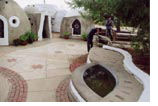 |
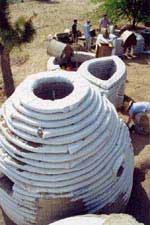
Khalili calls the material he uses for emergency shelters “Superadobe.” With it, he builds structures primarily of sandbags and barbed wire – materials of war, turned to peaceful use. These shelters, which utilize domes and arches in their structure, have attracted the attention and acclaim of architects in the U.S. and around the world, as well as the United Nations. The U.N. has taken a great interest in using Khalili’s simple techniques to build emergency shelters for war refugees and for people left homeless by natural disasters.
During the early 1980s, Khalili began working with the scientific community, which saw great promise for space habitation in his ceramic, or “Superadobe” houses. His presentation at the National Academy of Sciences on the use of lunar soil to build simple structures on the moon drew cheers, and NASA is looking into Khalili’s techniques for use on Mars. The cost of launching building material into space is astronomical, so the idea of using on-site dirt and sand has great merit.
Khalili’s ability to use earth to build shelters makes incredibly effective and efficient use of readily available materials. Where conventional methods require all sorts of beams and foundation material to be brought in, the dome shape utilizes gravity, earth and building techniques that don’t require anything that’s not already there.
A world-renowned architect, Khalili left a successful business with offices in Tehran and Los Angeles to make it his life’s work to help those who need shelter. He says, “There are more than 800 million people who live in shantytowns made of scraps of tin and wood, or have no shelter at all. It has become my dream to find a solution to house these people.”
From the Cal-Earth Institute at the edge of the Mojave Desert, Khalili has worked for more than two decades to show that the solution he seeks does not require high-tech compounds or expensive construction techniques. Instead it will come, he believes, from the simplest of materials—sandbags, plastic tubing, wire, earth and fire. As for construction techniques, he says, “Imagine the concentric wooden doughnuts that you stack up as a children’s toy.”
 |
 |
Khalili believes that for those who are fortunate not to be in need of emergency shelter, his techniques can be adapted to build beautiful houses that are all but fireproof and cost 40-60 percent less than conventional buildings. He adds that energy savings from the use of natural materials to insulate against both heat and cold could pay for the entire cost of the house within a few years.
He frequently uses the word “sustainability” when describing his structures. They rely on materials and techniques that put little burden on distressed natural environments.
Khalili has the following message to share with humanity:
"There is a Sustainable Solution to Human Shelter, based on Timeless Materials (earth, water, air and fire) and Timeless Principles (arches, vaults and domes). Every man and woman should be able to build a shelter for his or her family with these universal elements, almost anywhere on the earth and other planets. These principles, interpreted into the simplest form of building technology have created emergency shelter which can become permanent houses, and which have passed strict tests and building codes. Since 1975 we have been dedicated to researching and developing this low-cost, self-help, eco-friendly technology which can resist disasters, and to offer it to humanity. The only missing link is to educate humans how to use these timeless techniques, developed at Cal-Earth Institute, to fit their own culture and environment." (from the Cal-Earth website)
Khalili’s Cal-Earth Institute provides this needed training and has catalyzed many decentralized networks, groups of people who have used their training to help those in need of emergency shelter around the world rebuild their lives and homes.
For more information, see the Cal-Earth website, or More SuperAdobe construction photos, and the The Eco-Dome.
Starfish Tip of the Month — Meetup.com
Meetup.com provides a free venue where people with similar interests can meet and share their ideas. Here is how Meetup describes their service:
We want to see the world's people self-organize. We believe that people can change their world by organizing themselves into groups—Meetups—powerful enough to make a difference. Meetups help people:
- Find others in their area who share their interests
- Learn, teach, and share things
- Make friends and have fun
- Rise up, stand up, unite, and make a difference
- Be a part of something bigger—both locally and globally
Meetup recently launched a sister service, Meetup Alliance. This free platform helps local groups team up to share ideas, coordinate efforts and make good things happen.
Rod features Twiki Wiki Meetups on his home page at BECKSTROM.COM and planned a Twiki Meetup in November at the Web 2.0 Conference in Berlin.
Starfish Book Reviews
A review of The Starfish and the Spider, written by an employee at Brickworks India, is now available in Tamil at Dinakaran.com.
Also, Rod was pleased to learn that The Starfish and the Spider was selected as one on the Best Business Audio books for 2007 by Audible. The retail version is scheduled to be out in May 2008.
Who We Are
Rod Beckström is an author, speaker, and the Chairman and Chief Catalyst of a new software company, TWIKI.NET. He founded CATS Software Inc., which he took public as CEO. Rod serves on the boards of Environmental Defense and Jamii Bora Africa Ltd. He is also on the board of the Pacific Council of Foreign Relations and on the Kiva.org Board of Advisors. Rod holds a BA and an MBA from Stanford and was a Fulbright Scholar. He lives in Palo Alto, California and can be contacted through BECKSTROM.COM.
The team at BECKSTROM.COM supports Rod with his writing, speaking engagements and web presence. To inquire about booking Rod for a speaking engagement, contact speaking@beckstrom.com. To schedule an interview with Rod for your publication or blog, contact sandra@beckstrom.com.
© 2008 WWW.BECKSTROM.COM